Claude Fable 5.2 Is Now on Risphai: Anthropic's Most Capable Model for Your Hardest Work
Claude Fable 5.2, Anthropic's most capable model, is now on Risphai for reasoning and coding on Premium. And Claude Opus 5.5 is now on every paid plan.
By Risphai
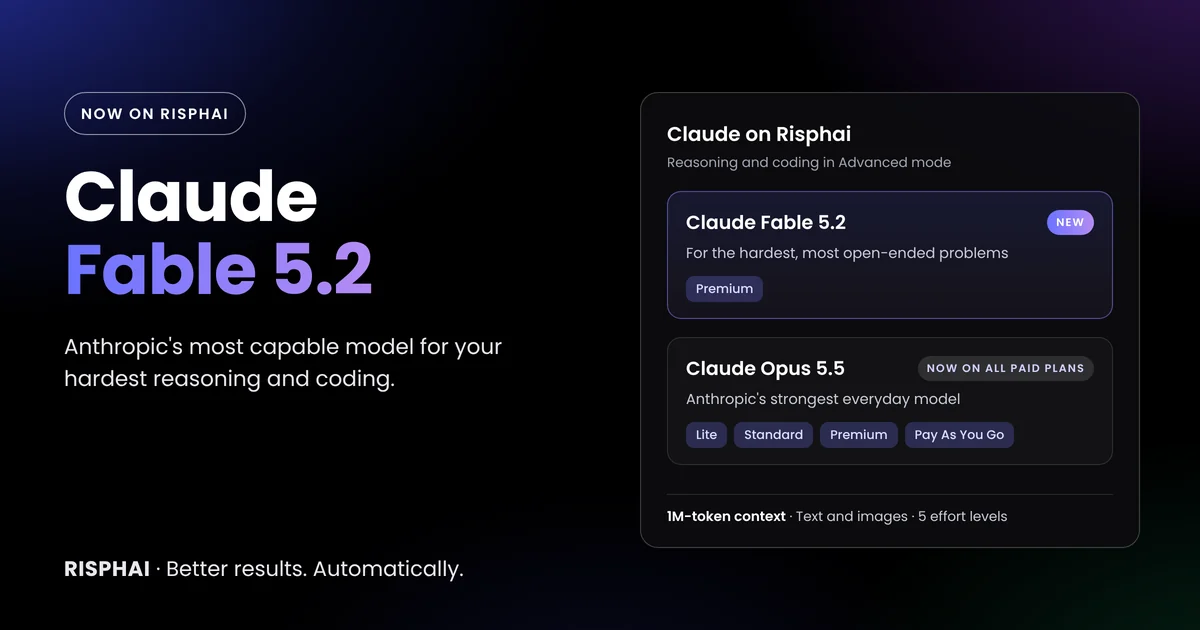
Claude Fable 5.2 joins Claude Opus 5.5 on Risphai. Fable 5.2 is on Premium, and Opus 5.5 is now on every paid plan.
Claude Fable 5.2 is now on Risphai. Anthropic released it on November 9, 2026 as its most capable model for the hardest reasoning and coding problems. You can use it today for reasoning and coding on the Premium plan. And there's more good news: Claude Opus 5.5 is now available on every paid plan, not just Premium.
Anthropic describes Fable as a model for the most daunting technical work. Fable 5.2 is its newest version. It's better at coding, reasoning and reading images than Fable 5.1, writes clearer answers, responds faster and costs less per AI word.
Two Changes for Claude on Risphai
Before
Now
Claude Fable 5.2
Not available
Reasoning and coding on Premium
Claude Opus 5.5
Premium only
Lite, Standard, Premium and Pay As You Go
If you're on Lite or Standard, you can now pick Claude Opus 5.5 in Advanced mode. Anthropic calls it its strongest everyday model, and you get it at the same plan price. Premium adds Claude Fable 5.2 on top for your hardest work.
Better coding, reasoning and vision. Anthropic reports gains over Fable 5.1 in all three, and says Fable 5.2 is a step above Claude Opus 5.5 in almost all the capabilities it tested.
Clearer answers. Testers found that it communicates more clearly than earlier Fable models.
Faster responses. Anthropic says it writes its answers up to 30% faster than Fable 5.1.
A lower price. Anthropic cut the price per AI word by 20% compared with Fable 5.1.
Long, ambitious work. Anthropic built it for long tasks with many steps, like in-depth analysis that ends in a finished document. During testing, Anthropic says the model helped its engineers finish software migrations that would otherwise have been too hard and designed three working electronic devices from scratch.
These are Anthropic's own statements. We haven't tested them ourselves, and results in your own work can differ.
Claude Fable 5.2 vs Claude Opus 5.5: Which Should You Use?
Both models are on Risphai, and they're made for different jobs:
Claude Opus 5.5
Claude Fable 5.2
Best for
Most everyday reasoning and coding
The hardest, most open-ended problems
Anthropic's advice
Start here
Move up when a task needs more
Credits per AI word
Half of Fable 5.2
2x Opus 5.5
Effort levels on Risphai
Low to Max
Low to Max
Context window
1 million AI words
1 million AI words
Zero Data Retention mode
Available
Not available
Plans
Every paid plan
Premium
Anthropic itself recommends starting with Opus 5.5 for most coding and knowledge work, then switching to Fable when a task needs more. That makes a simple rule: use Opus 5.5 by default, and switch to Fable 5.2 when a problem is very hard or the first answer isn't good enough. You can switch between them in the same chat.
What Claude Fable 5.2 Is Good At
Hard reasoning. Math, logic, science and questions where many steps have to be right.
Big coding tasks. Finding stubborn bugs, planning changes across a whole project and writing code you'd actually keep.
Long documents. Reading long reports, contracts or research papers and pulling out what matters.
Charts and screenshots. Reading charts, figures, diagrams and screenshots and explaining them.
Finished results. Turning messy input into a clear plan, analysis or report.
On Risphai, Claude Fable 5.2 can also run Python in reasoning and coding to check its math, analyze your data or draw charts, and runnable HTML, CSS and JavaScript can be previewed right in the chat.
Prompts to Try
"Find the bug in this code, explain why it happens and give me the fixed version." (with your code)
"Plan how to move this project from JavaScript to TypeScript, step by step, with the risks." (with your files)
"Read this research paper and explain the method, the results and the weak points." (with your file)
"What does this chart show? Check whether the conclusion in the caption really follows from the data." (with a screenshot)
"Prove this statement or show a counterexample, and explain each step."
"Build a small browser game in a single HTML file that I can play here."
Always double-check important answers, especially about money, law or health. AI can make mistakes.
Which Effort Level to Choose
Claude Fable 5.2 always thinks before it answers. The effort level sets how much:
Level
Best for
Low
Quicker answers to simpler questions
Medium
Most tasks, and a good place to start
High
Harder math, logic and multi-step coding
Extra High
Very difficult problems where accuracy matters most
Max
The hardest problems, when time and credits matter less
Higher levels usually give better results on hard problems, but take more time and credits. On very hard tasks, Fable 5.2 can think for several minutes. Risphai shows a summary of its thinking while it works.
Choose the Premium plan on the Pricing page. For Claude Opus 5.5, any paid plan works.
Switch to Advanced mode and open the model settings in the chat box.
Pick Claude Fable 5.2 Thinking under Reasoning or Coding, and choose the effort level.
Ask your question. You can save your selection as your default and switch models at any time.
If Claude Fable 5.2 is unavailable or your balance doesn't cover a request, Risphai automatically uses another model so your request still finishes, and shows you which model answered.
Claude Fable 5.2 Pricing on Risphai
Claude Opus 5.5
Claude Fable 5.2
Input, per million AI words
2,000 credits
4,000 credits
Output, per million AI words (including thinking)
10,000 credits
20,000 credits
For example, a request with 10,000 input AI words and 2,000 output AI words uses about 80 credits with Claude Fable 5.2 and about 40 credits with Claude Opus 5.5. Because thinking counts as output, harder questions and higher effort levels use more. Repeated parts of a conversation can be cached, which lowers the cost of long chats. Like every response, the total also includes the processing charge described in the Terms. The exact credits are shown for each response, and current prices are on the Claude Fable 5.2 model page.
Zero Data Retention. Anthropic requires 30-day data retention for Claude Fable 5.2, so it isn't available in Risphai's Zero Data Retention (ZDR) privacy mode. In ZDR mode, the model settings show it as unavailable, and Risphai uses an eligible model instead. Claude Opus 5.5 stays available in ZDR mode. Risphai doesn't train AI models on your conversations. See the Privacy Policy for how each privacy mode works.
Safeguards. Anthropic says Fable 5.2 has strong safeguards for cybersecurity and biology, with fewer unnecessary blocks than Fable 5.1. It may still decline some requests in those areas.
Try Claude Fable 5.2
Claude Fable 5.2 is live on Risphai now. Go Premium on the Pricing page, switch to Advanced mode and select Claude Fable 5.2 Thinking, or use Claude Opus 5.5 on any paid plan. You can see how the two compare on the Claude Opus 5.5 vs Claude Fable 5.2 page, and all changes in this release are in the v0.1.13 release notes.
Claude, Claude Fable, Claude Opus, Claude Mythos and Anthropic are trademarks of Anthropic, PBC. Risphai isn't affiliated with or endorsed by Anthropic. Model details and results are taken from Anthropic's public announcement and documentation as of November 10, 2026.
Claude Fable 5.2 is an AI model from Anthropic, released on November 9, 2026. Anthropic built it for the most demanding reasoning and long, multistep work, and says it improves on Claude Fable 5.1 in coding, reasoning and understanding images. It reads text and images and answers in text.
Is Claude Fable 5.2 available on Risphai?
Yes. Since November 10, 2026, you can choose Claude Fable 5.2 Thinking for reasoning and coding on the Premium plan, with five effort levels from Low to Max.
Is Claude Fable 5.2 better than Claude Opus 5.5?
For the hardest problems, according to Anthropic, yes: Anthropic says Fable 5.2 is a step above Opus 5.5 in almost all the capabilities it tested. It also costs twice as many credits per AI word and can take longer to answer. Anthropic recommends Opus 5.5 as the everyday model for most coding and knowledge work, and Fable 5.2 for the most ambitious, open-ended problems.
Which plans include Claude Fable 5.2 and Claude Opus 5.5?
Claude Fable 5.2 is included in the Premium plan. Claude Opus 5.5 is now available on every paid plan: Lite, Standard and Premium, and with Pay As You Go credits. Both are used for reasoning and coding, and you choose them in Advanced mode.
How much does Claude Fable 5.2 cost on Risphai?
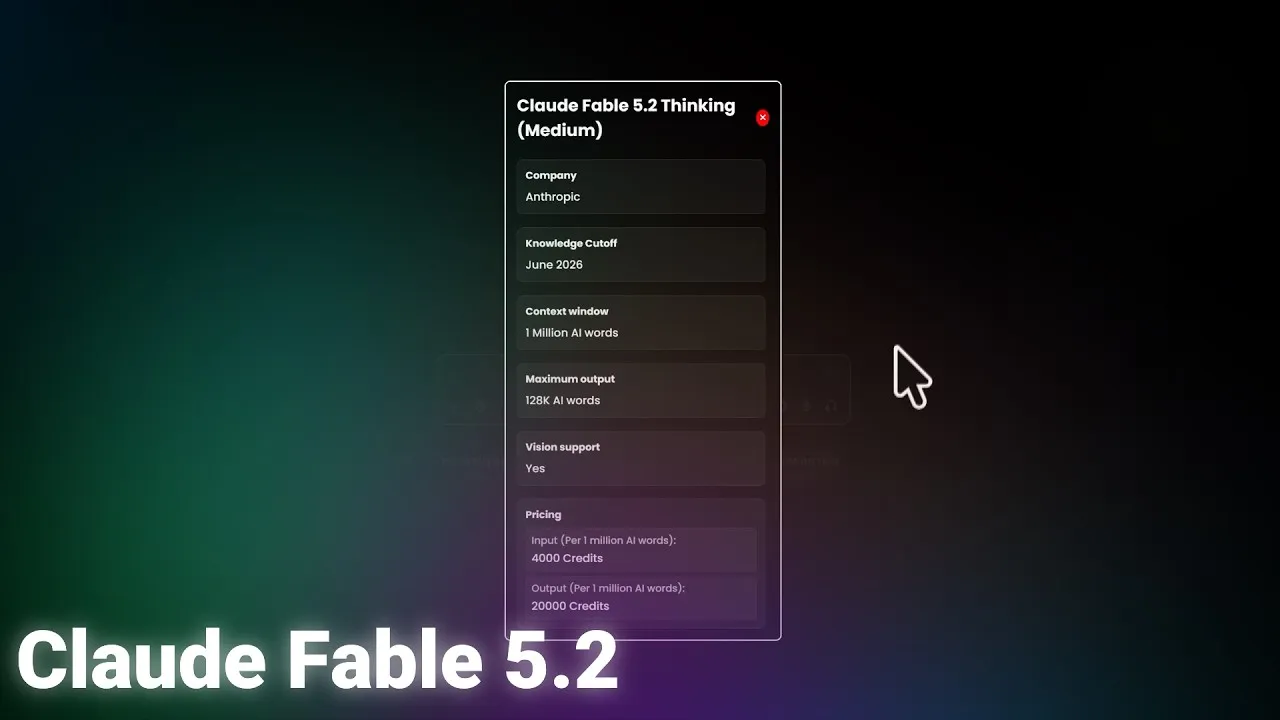
Claude Fable 5.2 costs 4,000 credits per million input AI words and 20,000 credits per million output AI words, including thinking. For example, a request with 10,000 input AI words and 2,000 output AI words uses about 80 credits, plus the processing charge. Premium includes 20,000 credits every month, and you see the exact credits for each response.
Can I use Claude Fable 5.2 for free?
No. The Free plan includes 100 credits every month and Risphai picks the models for you. Claude Fable 5.2 needs the Premium plan, and Claude Opus 5.5 needs a paid plan or Pay As You Go credits.
What is the difference between Claude Fable 5.2 and Claude Mythos 5.2?
Anthropic says they are the same underlying model. Fable 5.2 has extra safeguards for cybersecurity and biology, which lets Anthropic offer it to everyone. Mythos 5.2 is only for organizations approved through Anthropic's verification programs. Risphai offers Claude Fable 5.2.
What is the context window of Claude Fable 5.2?
Anthropic lists a context window of 1 million AI words and up to 128,000 output AI words for Claude Fable 5.2. That is enough for very long documents, large codebases and long conversations.
What is the knowledge cutoff of Claude Fable 5.2?
Anthropic lists June 2026 as the knowledge cutoff for Claude Fable 5.2. On Risphai, the model can use web search when a question needs newer information.
Can I use Claude Fable 5.2 with Zero Data Retention?
No. Anthropic requires 30-day data retention for Claude Fable 5.2, so it isn't available in Risphai's Zero Data Retention (ZDR) privacy mode. Claude Opus 5.5 is available in ZDR mode. In both privacy modes, Risphai doesn't use your conversations to train AI models. See the Privacy Policy for details.
Which effort level should I use for Claude Fable 5.2?
Start with Medium or High. Use Low for quicker answers, Extra High for very hard problems and Max only when the best possible answer matters more than time and credits. Higher levels let the model think longer, which takes more time and credits.
claude fable 5.2fable 5.2claude fableanthropic fableclaude-fable-5-2claude mythos 5.2claude opus 5.5anthropicai models